
Rock County Bench Warrants Explained
Minnesota courts say bench warrant, and they say warrant for failure to appear just as often. Both labels point to the same thing: a judge's order that follows a missed court obligation or a ignored direction in a case. There is no separate Rock County category, so the case file is what tells you which process applies. Common triggers include missing an appearance on a summons or citation, leaving a court-ordered obligation unpaid, and failing to finish a condition such as a program. Each trigger can start a different process. That is why the label on the order matters so much. Note: A missed date in Rock County does not by itself prove a warrant exists, nor does it show which type was issued.
The Rule 8 FTA Form, Field by Field
The state publishes a blank warrant form under Rule 8 of the Minnesota Rules of Criminal Procedure. It is the clearest picture of what a failure-to-appear record holds. The sample is not a Rock County case.
| Court identity | State of Minnesota, District Court, county, and judicial district |
|---|---|
| Case and party | District Court File No., and the defendant's name or a sufficient description |
| Application | Failure to appear after a Complaint-Summons or citation, plus the issuing official and service date |
| Prosecuting attorney | Signature, printed name, license number, and date |
| Warrant terms | Direction to the sheriff, the offense, release conditions, bail amount, and the judge's signature |
| Return direction | Prompt appearance before the issuing court, and no later than 36 hours after arrest if court is not in session |
The blank Rule 8 warrant form shows the questions Court Administration asks about a Rock County bench warrant.
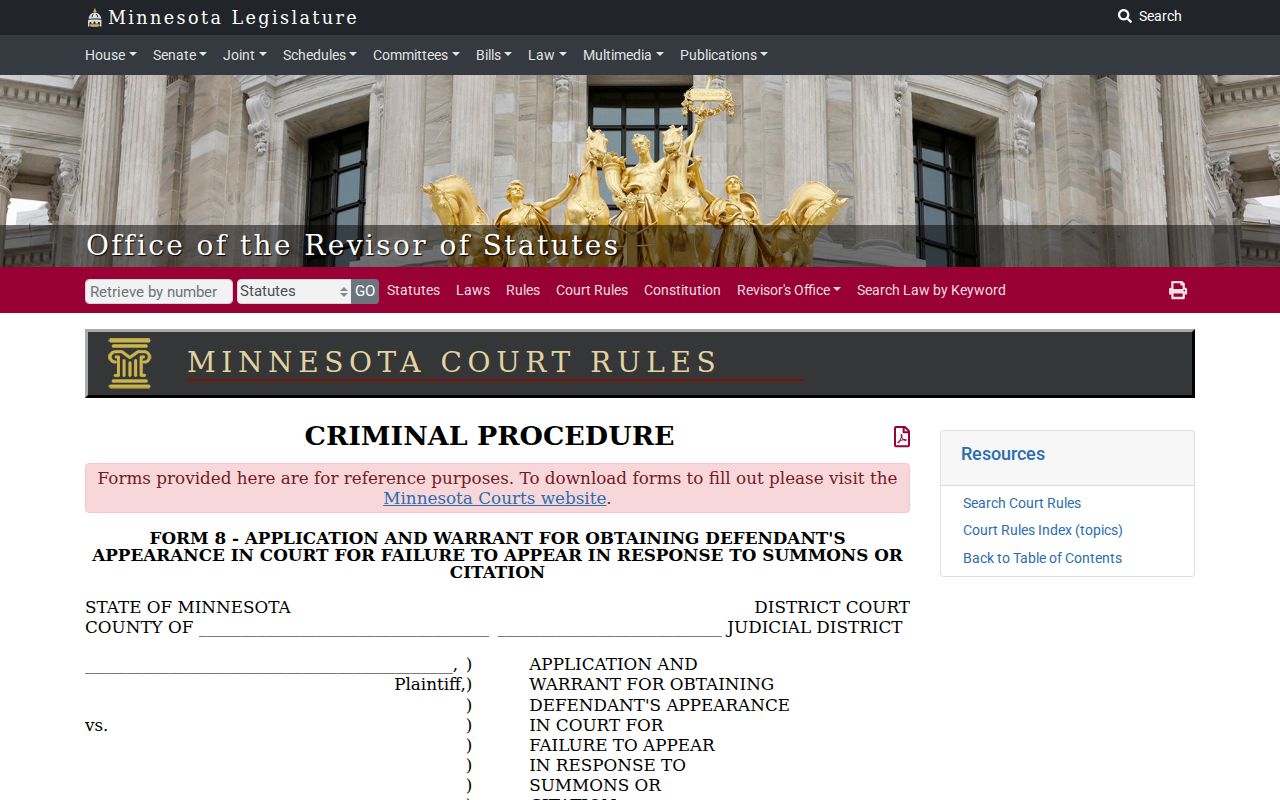
The failure-to-appear section is the part that matters here. A Rock County case file carries the same elements.
How Rock County Bench Warrants Are Issued
The sequence is short and documented. A defendant gets served with a summons or citation, then the obligation is missed. A prosecutor or issuing official applies for process, the judge weighs whether the warrant conditions are met, and the court records the event.
- A summons or citation sets the obligation and the date.
- A missed appearance or unmet condition is recorded in the case.
- An application for process is filed with the court.
- The judge finds whether the warrant conditions are satisfied.
- The order names the offense and any bail or release terms.
- A later order or appearance can change the status.
Rule 3 makes a summons the ordinary route and a warrant the exception. The reasons: the person seems unlikely to appear, the address cannot be found, or harm is imminent.
Sign-and-Release Is a Different Process
One failure-to-appear process in Minnesota works differently. Under Minn. Stat. §629.415, a sign-and-release warrant can apply after a mailed summons comes back undeliverable on a first failure to appear. It requires no bail. It does not authorize arrest either. The record must name the process as sign-and-release. An officer who encounters the person simply gives notice of a new court date. A prosecutor can still seek bail if the statute's safety standard is met, so this is no amnesty program and no blanket protection, and it is not a synonym for every bench warrant.
- Bench warrant
- A judge's warrant that can authorize arrest.
- FTA warrant
- The failure-to-appear process behind most bench warrants.
- Sign-and-release warrant
- A narrow statutory process with no bail and no arrest authority.
- Capias
- A term from other states; Minnesota sources reviewed here do not use capias pro fine.
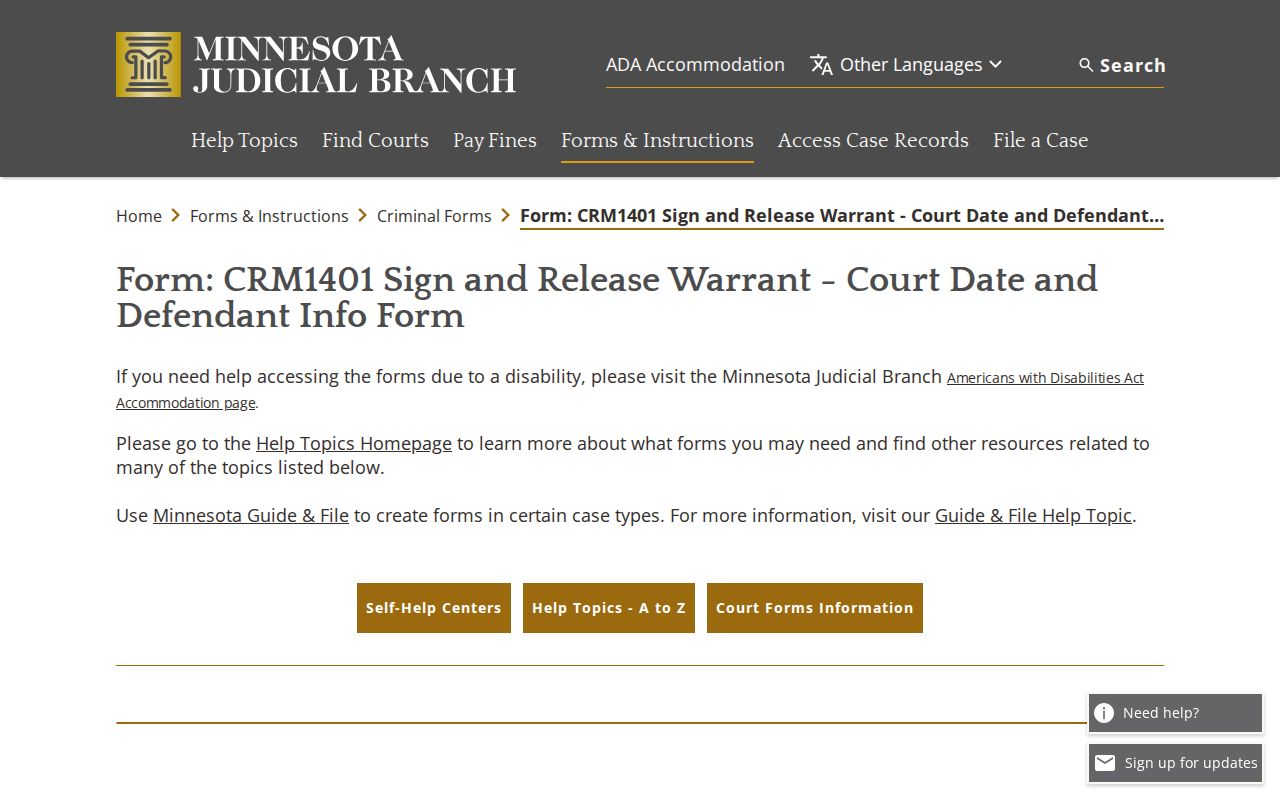
The CRM1401 sign-and-release form lists the court date and defendant information gathered for a Rock County case under that process.
Bench Warrants and Arrest Warrants Compared
A bench warrant and an arrest warrant can look alike on paper, yet they do different work. In Rock County, a bench warrant grows out of something that happened after a case began, like a missed date, while an arrest warrant grows out of the charge itself.
| Point | Bench or FTA warrant | Arrest warrant |
|---|---|---|
| What triggered it | A missed appearance, payment, or court direction | Probable cause in a complaint, with a reason a summons will not do |
| Who issues it | Rock County District Court judge | Rock County District Court judge |
| Authorizes arrest | Usually yes, unless it is a sign-and-release warrant | Yes |
| Bail | Set by the order, or not required for sign-and-release | Set by the order |
| Records route | Register of Actions in the existing case | Complaint and warrant entries in the case |
For the charge-based kind, the Rock County arrest warrant search page lays out the paperwork.
What a Missed Date Does Not Tell You
A missed court date proves exactly one thing: the obligation went unmet that day. Everything beyond that lives in the file. It cannot show whether the judge issued a bench warrant, whether bail was set, or whether a sign-and-release process applies. Nor can it reveal whether payment resolves the matter, or whether an active warrant appears in a public index. A county list being unavailable never means the warrant is gone; only the issuing court can confirm or recall it. The Rock County court calendar is posted each business day and updated hourly, but it leaves out confidential matters and is not a warrant database, so a clear calendar settles nothing on its own.
Resolving a Rock County Bench Warrant
A bench warrant gets resolved by the court itself. Rock County's own guidance warns that calling the court or the sheriff about a warrant can end in custody, and that warning should shape the order of your steps.
Caution: Call an attorney before you appear at a Rock County counter about a bench warrant, because the state's own guidance says a voluntary contact can result in custody.
Ask narrow questions. What type of process was issued, and is it still active? Is there bail or a release condition, and where should the person appear? In Rock County, Court Administration walks you through the file and the filing logistics, while an attorney makes the legal judgment calls. The sign-and-release question matters most before anyone makes contact.
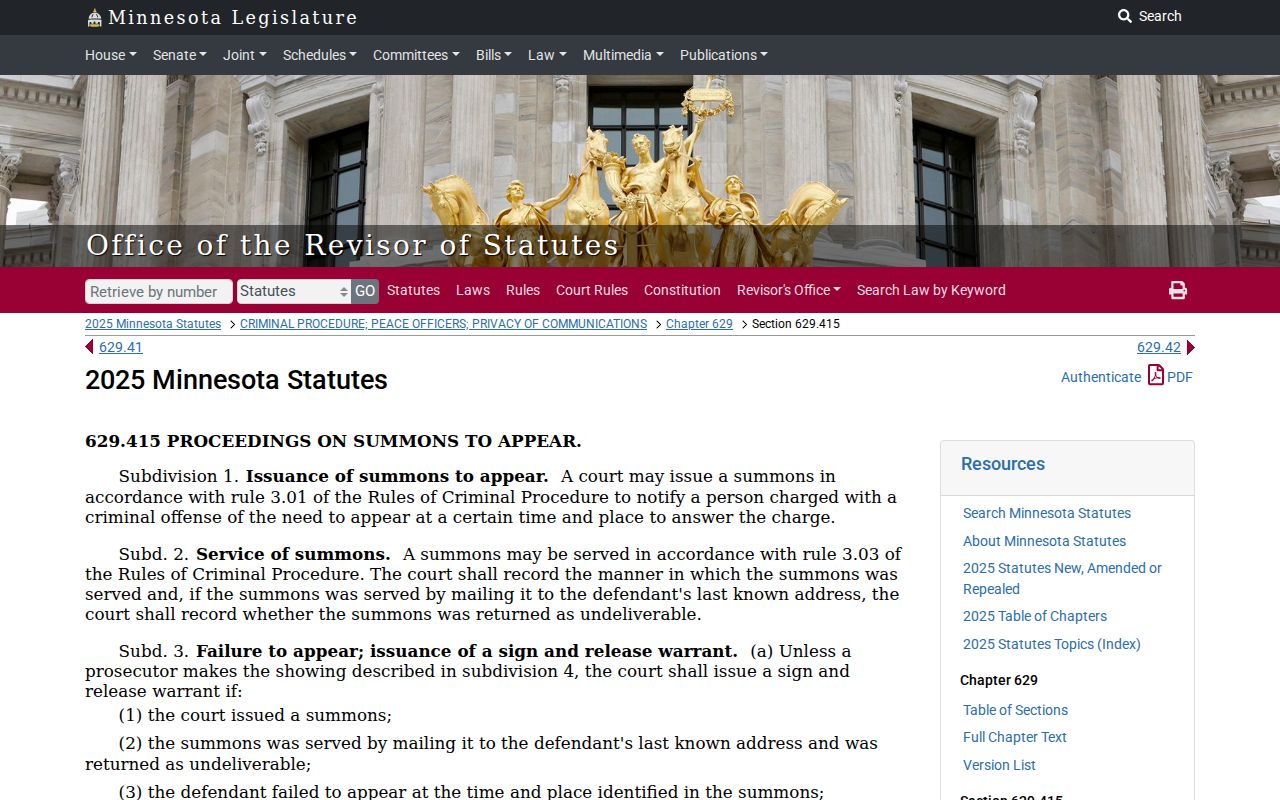
Read the sign-and-release statute first. It decides whether a missed Rock County date can end in custody at all.
A Missed Rock County Date: What to Do
Begin with the case record, not a phone call. Search Minnesota Court Records Online by name, case number, or citation number, narrow the results to Criminal and Rock County, and read the Register of Actions; write down the case number and the entries you see. Then call Rock County Court Administration with two questions: is the bench warrant still active, and is a sign-and-release process available. If the person is already in custody, the Nobles County Jail handles booking and account questions.
Finding the Court That Issued the Warrant
Rock County District Court in Luverne is where most of this starts. That court holds original jurisdiction over every criminal and traffic case filed in the county. It sits in the Fifth Judicial District. Search warrants are the one exception worth knowing. They target a place, a person, or property instead of a missed court date. The state's media guidance says these warrants are reviewed at a courthouse terminal and may be sealed, so a bench warrant lookup in Rock County usually points back to the district court itself.
Rock County Recall and Surrender Details
Some practical pieces are simply not published. Rock County offers no official recall or quash form, and no walk-in surrender window exists. No source says whether a person should go to the Sheriff's Office, the courthouse, or the contracted jail. So call first. Court Administration can confirm the current instruction, and an attorney can too. Whatever new date, order, or receipt comes out of it, get it in writing. A records request can produce a nonconfidential copy of a document, but it never recalls a warrant.